
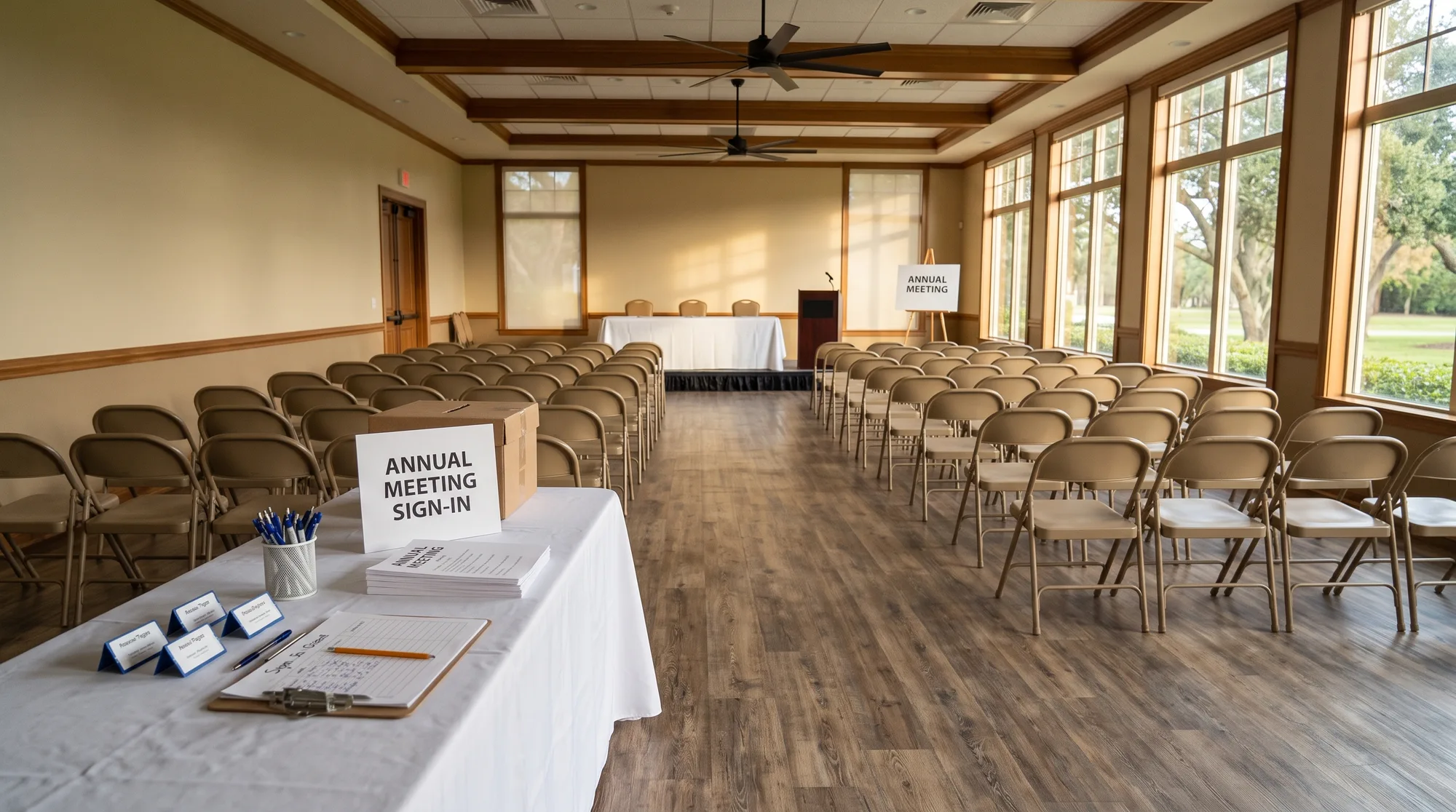
How to prepare for your HOA annual meeting (timeline, agenda, and a free kit).
The date’s on the calendar, the notice hasn’t gone out, and someone at the last board meeting just asked whether you’ll have quorum. If your annual meeting is one to three months away, you’re right on time.
The short version
Start about eight weeks out and plan backward from your notice deadline. Your bylaws set the exact rules; this guide gives you the order: confirm the rules, call for candidates, prepare the financials, send notice on time, chase quorum, run a fair election, and close the loop. The free kit turns it into a checklist, a notice template, and an agenda.
This guide gives you a week-by-week timeline, a sample agenda, a plan for quorum and elections, and a free kit you can use this week.
What is an HOA annual meeting?
The HOA annual meeting is the once-a-year meeting of all members where homeowners elect board members, hear the association’s financial report, and often review the budget. Most bylaws require one, and several Gulf South states require it by statute even when the documents are silent. Your bylaws probably call it the annual meeting of members.
It’s different from a regular board meeting. Board meetings are where directors handle the ongoing work of the association, sometimes with an executive session for sensitive matters. The annual meeting belongs to the homeowners. It’s the one time a year the whole community sees the board’s work, the financials, and the plan for next year. Boards that prepare well walk into a room of homeowners who already trust the numbers.
Your bylaws set when the HOA annual meeting happens and what has to be on it, and state law may add requirements or override the documents.
Your HOA annual meeting timeline, week by week
Start about eight weeks out, because notice deadlines and candidate calls take longer than boards expect. The order is what matters; the exact days come from your governing documents and state law. The kit’s checklist uses these same seven stages and opens with a worksheet for the rules in your documents and state law (notice window, delivery, quorum, proxies, and electronic voting).
1. Eight weeks out: confirm the rules and the room
Confirm the date, time, and place, or the virtual format, against your bylaws. Pull the rules for notice, quorum, proxies, and voting from your governing documents and from any state statute, and write them down in one place. Where the two conflict, the statute can override the documents. Then book the room before someone else’s baby shower does.
2. Six to eight weeks out: call for candidates and decide how voting works
Send the call for board candidates, with a deadline that leaves time to include their statements in the notice. Decide how voting will work: in person, by proxy, by ballot, or electronically where your documents and state law allow it.
3. Four to six weeks out: prepare the financials and draft the agenda
Prepare the financial report and, where applicable, the proposed budget. Draft the agenda from the sample below.
4. By your notice deadline: send the official notice
Send the official meeting notice with the agenda, candidate information, and any proxy or ballot, inside the notice window your documents and state law set. Some statutes set both a latest and an earliest date, so sending too early can be a problem, too. Every other date on this list should count backward from that window.
5. Two weeks out: remind and track
Send a reminder. Track proxies or ballots received against the quorum you need, so you know early whether to push harder.
6. Meeting week: set up and assign roles
Print sign-in sheets and ballots, confirm who is counting votes, and set up the room or test the meeting link.
7. After the meeting: close the loop
Announce the results, update the board roster, and file the minutes.
What goes on an HOA annual meeting agenda
A typical HOA annual meeting agenda covers call to order and quorum, approval of last year’s minutes, the president’s report, the financial report and budget, the election, open forum, and adjournment. Here’s the sample from the kit, item for item:
- Call to order
- Establish quorum
- Proof of notice
- Approve last year’s annual meeting minutes
- President’s report
- Financial report and budget
- Election of directors
- Unfinished and new business, as the bylaws allow
- Open forum
- Announce election results
- Adjourn
If your community presents or ratifies the budget at the HOA annual meeting, give the budget presentation real time on the agenda and have copies ready. Presenting the budget is common; a member vote on it happens only where your documents or state law call for one, since many boards adopt the budget themselves. Our HOA budget template walks through building one homeowners can follow. For open forum, set a time limit per speaker that fits your documents and state law (some states set a minimum) and announce it before the first hand goes up. If your bylaws adopt Robert’s Rules of Order, the official site is a useful reference for motions and procedure. A clear agenda, sent with the notice, keeps the meeting on schedule and the surprises to a minimum.
HOA meeting notice requirements: get this part right
Your bylaws and state law set how far in advance notice must go out, how it’s delivered, and what it has to include, and a meeting held on defective notice can be challenged. Of all the HOA annual meeting requirements, this is the one where close enough isn’t good enough.
A meeting notice typically includes:
- The date, time, and place, or the meeting link
- The agenda
- Board seats up for election and candidate information
- How to vote or give a proxy
- A contact for questions
Electronic notice may be an option where your documents and state law allow it. Check your HOA meeting notice requirements before the notice goes out, not after. We manage communities. We don’t practice law. For the rules where you are, find your state’s HOA law guide in our Resources library.
HOA annual meeting quorum: how to reach it, and what to do if you don't
Quorum is the minimum number of members, present or represented, that the bylaws require for the meeting to conduct business. Without it, the members generally can’t hold the election or vote on anything at the meeting, and everyone who showed up goes home a little annoyed.
How to reach quorum
Turnout is mostly a communication job. Start early, send reminders, make proxies or ballots easy to return, and offer a virtual option where your documents allow it. Tell homeowners plainly why it matters: without quorum, the HOA annual meeting can’t do its business. In CMGT communities, 70% of homeowners use the portal, which makes reminders easier to send and returns easier to track. The best quorum plan starts with the first notice, not the week of the meeting.
If you don't reach quorum
Many bylaws allow the meeting to adjourn and reconvene as an adjourned meeting, sometimes with a lower quorum. Some states also allow an election by absentee or electronic ballot without a meeting, where the documents permit it. Check what yours say before the meeting, so the board walks in with a plan instead of improvising. Know your documents’ rule for a missed quorum before you need it. Your association’s attorney and your state’s HOA law guide can confirm what applies.
Running a fair HOA board election
A fair board election follows the voting procedures in your documents, treats every candidate the same, and has someone other than a candidate count the votes. HOA voting rules and HOA election rules vary by governing documents and state law, and some states add their own, like candidate deadlines or who may count ballots. Start there. Most fair elections share the same parts:
- An open candidate call, sent to every homeowner with the same deadline.
- Candidate statements distributed with the notice, in the same format for everyone.
- Ballots and proxies handled exactly as your HOA voting procedures require, including how a proxy form is signed and returned, if proxies are allowed.
- Counting by the manager or volunteer inspectors who aren’t on the ballot.
- Results announced at the meeting and recorded in the minutes.
The Community Associations Institute’s governance guidelines recommend letting each candidate have a representative observe the count. A transparent count is what makes people accept the result.
In person, virtual, or hybrid?
In-person meetings build trust, virtual and hybrid options raise turnout, and which you can use depends on your documents and state law. Some board members and homeowners want a room, a printed agenda, and a handshake. Others would rather join from the kitchen table after the kids are in bed. A hybrid meeting can serve both. If you go hybrid, hand the technology to one person who isn’t also running the meeting.
Your free HOA annual meeting kit
The kit turns this guide into three fill-in pages you can use in your browser:
- A week-by-week checklist with the same seven stages as the timeline above, plus a worksheet for your documents’ rules. Enter your meeting date and it fills in a planning target for each stage.
- An HOA annual meeting notice template that builds itself as you fill it in, with every legal requirement left as a blank.
- An HOA annual meeting agenda template that matches the sample agenda, item for item.
Your entries save in your own browser, not on our site. The notice and agenda print without CMGT branding, ready to send. Prefer paper? The blank copy prints every field as a line. Open the kit or print a blank copy (PDF).
Frequently asked questions about the HOA annual meeting
What happens if an HOA doesn’t have an annual meeting?
The board may be out of compliance with its bylaws and, in some states, with statute. Some states give homeowners a formal way to demand a meeting or force an election, and directors staying on after their terms end doesn’t replace the duty to hold one. The consequences depend on your governing documents and state law, so check your state’s guide and your attorney.
Is it mandatory for homeowners to attend the HOA annual meeting?
Generally, no. But the meeting can’t do business without quorum, so every homeowner who attends or returns a proxy or ballot helps the community get its work done, including electing the board.
What is a quorum for an HOA annual meeting?
It’s the minimum share of members, present or represented, that your bylaws or state law require before the meeting can conduct business. Your governing documents state the number for your community.
How far in advance do you have to send notice of an HOA annual meeting?
Whatever your bylaws and state law require, and that varies. Find the deadline first, then build the rest of your timeline backward from it. Your state’s HOA law guide in our Resources library is a good place to start.
Can an HOA hold its annual meeting virtually?
Many can, if the governing documents and state law allow it. Check both before you send the notice, since the notice needs to say how homeowners can join.
Start early, follow your documents
Start eight weeks out, follow your documents, and treat the HOA annual meeting as the year’s best chance to show homeowners the board’s work. When the notice is right, the numbers are clear, and the election is fair, the meeting mostly runs itself. Board meeting preparation, attendance, and minutes are part of CMGT’s HOA management services.
This article and kit are free planning resources for HOA boards, not the process CMGT uses to run meetings for the communities it manages, and not legal advice. Notice, quorum, proxy, and voting rules vary by governing documents and state law; confirm your community’s requirements with your association’s attorney.